
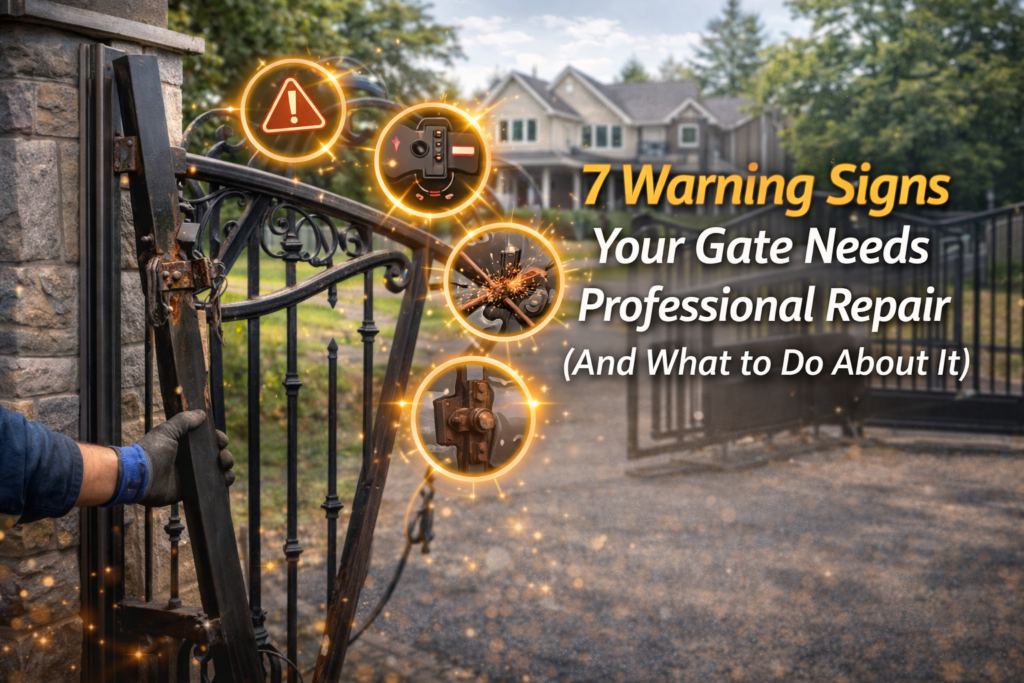
Your gate is one of the hardest-working parts of your property. It opens and closes dozens of times a day, weathers every season, and holds the line between your home and the outside world. Most homeowners don’t think twice about it—until it breaks down at the worst possible moment.
The good news? Gates rarely fail without warning. They give you plenty of signals before they reach the point of no return. Learning to recognize those signals early can save you hundreds of dollars in emergency repair costs and spare you the frustration of a gate that simply won’t cooperate on a busy morning.
In this post, we’ll walk through the seven most telling signs that your gate needs professional attention, what’s likely causing each problem, and how prompt repair protects both your investment and your peace of mind.
1. The Gate Makes Grinding or Scraping Noises
A healthy gate should operate quietly. If yours has started grinding, scraping, or squealing every time it moves, that’s a clear sign something is off. The culprit is usually worn-out rollers on a sliding gate, misaligned tracks, or dry hinges that haven’t been lubricated in too long.
Left untreated, these friction issues accelerate wear on every moving component. What starts as an annoying noise can quickly become a motor burnout or a warped track—repairs that cost significantly more than simple lubrication and roller replacement.
If you’re in Southern California, the combination of heat and occasional dusty winds makes this problem more common than in cooler climates. Debris packs into tracks and grinds against rollers, and the temperature swings expand and contract metal parts in ways that loosen fittings over time.
2. The Gate Moves Slower Than Usual
Automated gates are designed to open and close at a specific speed. If yours has slowed noticeably without anyone adjusting the settings, the motor is likely straining against a mechanical problem elsewhere in the system.
Common causes include track obstruction, a failing motor capacitor, misaligned limit switches, or worn drive gears. A motor working too hard to compensate for these issues will overheat and fail prematurely. Catching it early—when the gate is just slow, not stopped—is the difference between a minor repair and a full motor replacement.
3. The Gate Doesn’t Fully Open or Close
A gate that stops halfway or reverses before completing its cycle is one of the more frustrating problems to deal with. It’s usually caused by sensor issues, obstruction detection triggering falsely, or limit switches that have slipped out of calibration.
On swing gates, it might mean a hinge has shifted or the ground beneath one of the posts has settled unevenly—a common issue in areas with expansive clay soils. Whatever the root cause, a gate that can’t complete its full range of motion is a security liability. An incompletely closed gate is essentially an open invitation.
4. You Notice Rust, Rot, or Visible Structural Damage
Aesthetic problems and structural problems are often the same problem at different stages. Surface rust on a wrought iron gate, for example, might look like a cosmetic issue—but rust spreads. It weakens welds, deteriorates hinges, and eventually compromises the structural integrity of the entire gate.
Wooden gates face a parallel challenge. What starts as surface weathering or a small crack quickly becomes rot if moisture gets in and isn’t addressed. Once rot spreads to load-bearing sections of the frame, the gate needs more than repair—it needs rebuilding.
Catching rust and rot early, treating and sealing affected areas, and reinforcing weakened sections is far cheaper than full replacement. A professional inspection will tell you exactly how far the damage has progressed and what level of intervention is needed.
5. The Remote or Keypad Stops Working Reliably
Intermittent responsiveness from your remote or keypad is another early warning sign that something is wrong with your access control system. Before blaming the batteries or the remote itself, consider that the problem might be with the receiver, a corroded antenna connection, or interference from a new nearby device.
Access control issues can also stem from power fluctuations affecting the gate’s control board. Surge damage from electrical storms is more common than most people realize, and it doesn’t always kill a system outright—it degrades it slowly, causing the erratic behavior that leads homeowners to replace their remotes three times before realizing the receiver is the actual problem.
A professional technician can diagnose the exact source of the signal failure and fix it at the root, rather than applying temporary workarounds.
6. The Gate Has Started Sagging
A sagging gate is more than an eyesore. It signals that the structural support system—posts, hinges, or the gate frame itself—is failing. On a heavy iron gate, sagging puts enormous stress on the remaining hardware, accelerating its failure. The gate may drag along the ground, damaging both the gate and the driveway surface beneath it.
Post shifting is a common cause, particularly in regions where the ground expands and contracts with temperature and moisture changes. When a post shifts even slightly, the geometry of the entire gate is thrown off. Hinge wear is another frequent culprit, especially on gates that are opened and closed frequently without regular maintenance.
Realigning and resetting a sagging gate requires experience with how gates are properly tensioned and balanced. Done incorrectly, the fix may hold for a month before the sagging resumes.
7. You’ve Had to Reset the System More Than Once
If you’ve found yourself reprogramming your gate’s control panel, resetting limit switches, or manually releasing and re-engaging the motor more than once in a short period, that’s a pattern—not a coincidence. Repeated resets indicate an underlying issue with the control board, power supply, or mechanical components that keep falling out of adjustment.
This is the kind of problem that homeowners often patch repeatedly with quick fixes, spending more in aggregate than a single proper repair would have cost. A thorough diagnostic by a qualified technician can identify why the system keeps losing its settings and fix it for good.
Why Prompt Gate Repair Matters
Every one of the problems above follows the same trajectory: a small, fixable issue becomes a major, expensive one when ignored. Beyond the cost factor, a malfunctioning gate creates real security vulnerabilities. A gate that won’t close reliably, responds inconsistently, or can be manually pushed open due to structural weakness isn’t protecting your property.
For homeowners and businesses in Southern California’s Inland Empire, finding a local, experienced repair team matters. Someone who knows the regional climate conditions, understands how local soil and weather affect gate systems, and can respond quickly when a problem arises makes all the difference.
If you’re experiencing any of the signs above—or even if you just have a feeling something isn’t quite right with your gate—don’t wait for a full breakdown. Reaching out to a professional for an inspection is the smartest step you can take.
For residents of the Inland Empire, Gate Repair Corona specialists at Joe’s Fencing & Gates have been handling exactly these situations for over three decades. Whether it’s a minor adjustment, a motor replacement, or structural reinforcement, experienced local repair teams can have your gate operating properly—often within the same day.
A Final Word: Maintenance Prevents Most Repairs
The best gate repair is the one you never need. An annual maintenance check—lubricating moving parts, inspecting hinges, cleaning tracks, and testing the control system—catches the early warning signs listed above before they become serious problems.
Ask your repair technician to walk you through the basics of routine gate maintenance when they complete a repair. A few minutes of preventive care a couple of times a year will extend the life of your gate significantly and keep it operating reliably through every season.
Your gate works hard every day. A little attention goes a long way toward making sure it keeps doing its job—quietly, reliably, and on your schedule.