
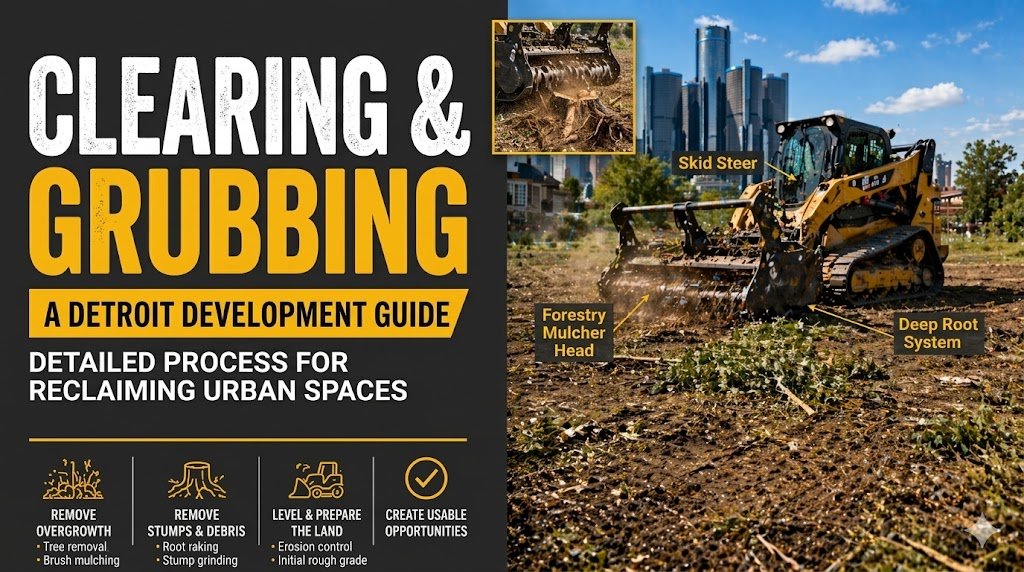
When land development professionals talk about preparing a site for construction, they often use the term “clearing and grubbing” a phrase that may be unfamiliar to property owners but represents one of the most thorough and important phases of land preparation. In Detroit, where redevelopment of urban and suburban land is a growing priority, Clearing and Grubbing Detroit is a fundamental service that prepares properties for productive new use.
Defining Clearing and Grubbing
Clearing and grubbing is a two-part land preparation process. Clearing refers to the removal of above-ground material trees, brush, shrubs, weeds, and any organic surface vegetation from a defined area. Grubbing refers to the removal of subsurface organic material primarily tree stumps, root systems, buried organic debris, and topsoil containing significant organic content.
Together, these two processes achieve a complete removal of all biological material from the construction zone, both above and below the surface. This is a more thorough and technically demanding operation than simple surface vegetation removal, and it is specifically required when the land will be built upon or when buried organic material would otherwise cause problems with soil stability or drainage.
Why Grubbing Is as Important as Clearing
Many property owners understand the need to remove trees and brush from a construction site, but the importance of grubbing removing what is underground is sometimes underestimated. Left in place, buried stumps, large root networks, and organic debris create serious problems over time.
As organic material decomposes below the surface, it creates voids in the soil. These voids cause uneven settling, which manifests as cracks in pavement, uneven floors, foundation movement, and drainage problems. In a construction context, this kind of settlement can compromise structural integrity and lead to costly repairs.
Root systems from cleared trees do not immediately stop growing or decomposing in some cases, root networks extend 20 to 30 feet from the original tree location and continue to decay for years after the tree is removed. In urban Detroit, where lots are narrow and trees are often planted close to structures, this is a particularly relevant concern. Grubbing ensures that these subsurface hazards are addressed before they become structural problems.
When Clearing and Grubbing Is Required
Clearing and grubbing is typically required for new construction projects where buildings, roads, or utilities will be installed. Any time a structure or paved surface will sit directly on or near ground that previously supported vegetation, grubbing is necessary to ensure the soil beneath is free of organic material.
Road construction projects routinely specify clearing and grubbing as the first item in the scope of work. The same is true for new residential subdivisions, commercial developments, and infrastructure projects such as parking lots, drainage systems, and utility corridors.
In Detroit’s urban context, clearing and grubbing is also relevant for the redevelopment of formerly residential parcels. Many vacant lots in Detroit are the former sites of homes that were demolished years ago. These lots may contain buried foundations, old root systems from long-removed trees, backfilled basement areas, and other subsurface conditions that must be addressed before new construction can begin.
The Clearing and Grubbing Process
A clearing and grubbing project begins with a detailed site assessment. The contractor identifies all vegetation, existing structures, buried utilities, and potential subsurface hazards. Utility locating required by Michigan law before any excavation activity is completed before clearing and grubbing begins.
The clearing phase proceeds first. Trees are felled using chainsaws and, in the case of larger specimens, aided by excavators to control the direction of fall and to safely lower large sections. Once felled, trees are cut into sections and either chipped, hauled away, or processed for timber value depending on species and condition. Brush and smaller vegetation is cleared mechanically using mulching attachments or cut and stacked for removal.
The grubbing phase follows. Excavators are used to remove stumps by cutting through and extracting the root ball. The size of the root ball depends on the species and age of the tree a mature oak tree, common in Detroit’s older neighborhoods, can have a root system that extends several feet in every direction from the trunk. Smaller root sections are typically removed through a combination of excavation and hand work.
Once stumps and major roots are removed, the disturbed soil is inspected and, where necessary, replaced with clean fill material. Areas where stumps or roots were removed often leave depressions that must be filled and compacted before the site can be graded or built upon. Topsoil containing high organic content may also need to be stripped and replaced with engineered fill in areas that will support structures or pavement.
Disposal and Material Management
The material generated by clearing and grubbing operations must be properly managed. Wood from cleared trees can be chipped and used as mulch, processed for biomass energy, or sold as firewood depending on the species and local market conditions. Stumps and root systems, because they contain soil and are often less clean than trunk wood, are typically ground or chipped and composted or disposed of through appropriate channels.
In Michigan, open burning of cleared vegetation is regulated and often prohibited in urban areas such as Detroit. Contractors must plan for alternative disposal methods, which is an important consideration when estimating the time and cost of a clearing and grubbing project.
Soil management is also a consideration. In Detroit, many urban sites have a history of industrial or commercial use, and subsurface soil conditions may include contamination from prior activities. If contaminated soil is discovered during grubbing operations, it must be managed in compliance with EGLE regulations, which may involve testing, segregation, and disposal through licensed facilities.
Erosion and Environmental Controls
Clearing and grubbing exposes large areas of bare soil that are vulnerable to erosion from wind and water. Responsible contractors install temporary erosion control measures including silt fences, erosion control blankets, and sediment traps during and after clearing and grubbing to prevent soil loss and protect stormwater systems.
Where clearing and grubbing activities occur near regulated wetlands, waterways, or sensitive natural features, additional precautions are required. Michigan’s environmental regulations protect these areas, and work in or adjacent to them may require permits from EGLE and other agencies.
Final Thoughts
Clearing and grubbing is one of the most thorough forms of land preparation available, addressing both the visible surface and the hidden underground conditions that determine how well a construction project will perform over time. In Detroit, where the redevelopment of urban land is reshaping neighborhoods and creating new opportunities, this comprehensive approach to site preparation is an essential service.
Understanding what clearing and grubbing involves and why the grubbing portion is just as important as the clearing helps property owners and developers plan their projects with realistic expectations and a firm understanding of what makes new construction last.